
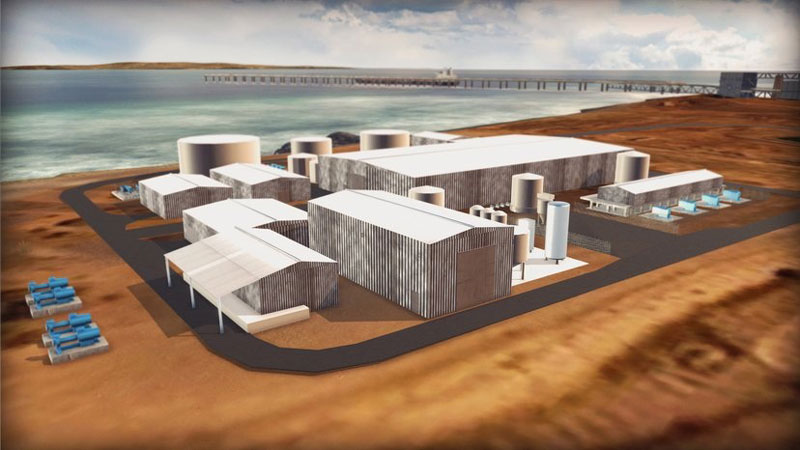
Rendering: Rio Tinto
Rio Tinto and the Western Australian Government have entered into a 50:50 joint venture to complete both Stage 1 and Stage 2 of the Dampier seawater desalination plant. Once fully operational, the plant will deliver 8 gigalitres of desalinated water per year to the West Pilbara Water Supply Scheme, reducing pressure on regional aquifers.
The joint venture builds on a 2025 Memorandum of Understanding, under which the WA Government and Rio Tinto agreed to work together to strengthen water security in the Pilbara.
The A$1.1 billion Dampier seawater desalination plant, which will be operated by Rio Tinto, will considerably reduce groundwater take and help protect sites of environmental and cultural importance. Construction of Stage 1 of the plant is underway and is expected to begin delivering 4 GL of annual desalination capacity later this year.
Stage 2 construction, which will add a further 4 GL of annual capacity, has also commenced, with first water expected in 2027. Together, Stages 1 and 2 will significantly reduce abstraction from the Bungaroo and Millstream aquifers.
“We understand water is a scarce resource, especially in the Pilbara. Bringing on the Dampier seawater desalination plant is an important step as we work to reduce our reliance on groundwater abstraction,” Rio Tinto Iron Ore Chief Executive Matthew Holcz said.
“Stage 1 of the Dampier seawater desalination plant will reduce our draw on the Bungaroo aquifer, which we recognise is deeply important to the Robe River Kuruma People. We are pleased to partner with the Western Australian Government to improve the security and sustainability of water supply throughout the Pilbara.”
The West Pilbara Water Supply Scheme is operated by Water Corporation and supplies the towns of Karratha, Wickham, Dampier, Roebourne, Point Samson, and the industrial areas of Cape Lambert and the Burrup Peninsula.
Source: Rio Tinto